
In the fast - evolving landscape of graphics processing units (GPUs), NVIDIA continues to set the benchmark with its GeForce RTX series. The launch of the GeForce RTX 5090 has sparked intense curiosity among gamers, content creators, and professionals: how does this new flagship GPU compare to its predecessor, the RTX 4090? Let’s dissect the key upgrades, architectural changes, and performance metrics to understand what makes the RTX 5090 a worthy successor.
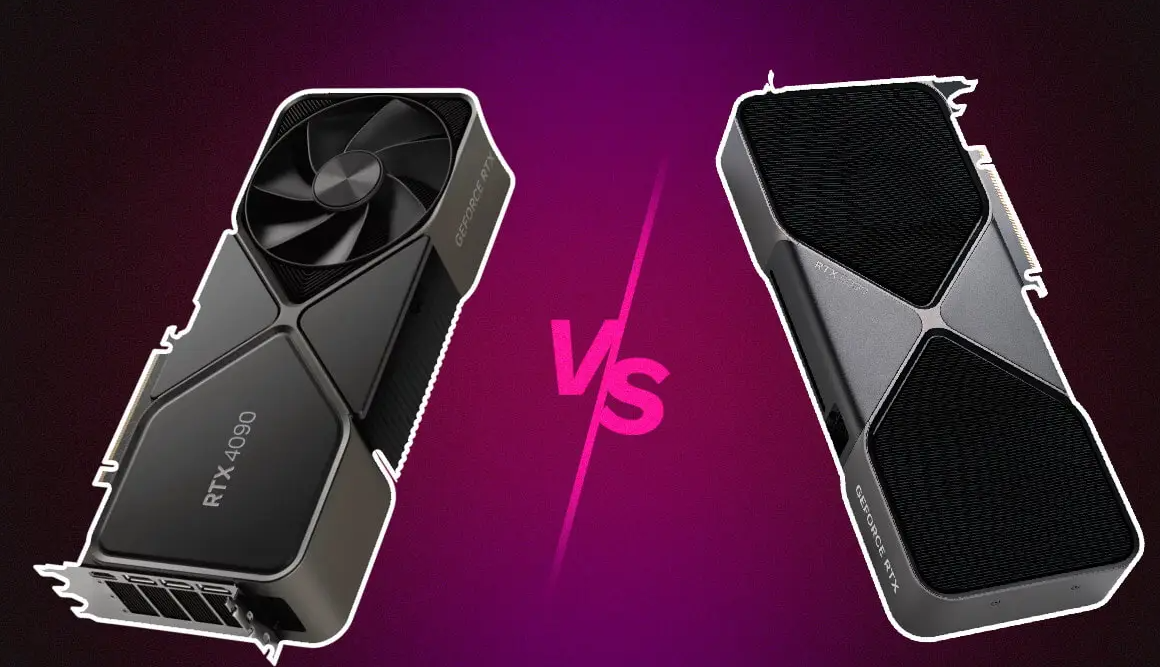
The RTX 4090 is built on NVIDIA’s Ada Lovelace architecture, introduced in 2022. This architecture brought groundbreaking improvements, including a larger L2 cache, third - generation ray - tracing (RT) cores, and fourth - generation Tensor cores. Housed on the AD102 GPU, the RTX 4090 features 128 Streaming Multiprocessors (SMs), each packed with CUDA cores, RT cores, and Tensor cores for parallel computing tasks.
The RTX 5090 debuts NVIDIA’s Blackwell architecture, a significant leap forward. Powered by the B102 GPU, it introduces 170 SMs—a 33% increase over the RTX 4090. This architectural upgrade enables higher parallel processing capabilities, crucial for both gaming and compute - intensive workloads like AI training, 3D rendering, and scientific simulations.
RTX 4090: 16,384 CUDA cores, optimized for general - purpose computing and graphics rendering.
RTX 5090: A massive 21,760 CUDA cores—a 33% increase—delivering unparalleled compute throughput.
In floating - point performance tests, the RTX 5090 shines:
FP16 Performance: 104.8 TFLOPS (RTX 5090) vs. 82.58 TFLOPS (RTX 4090), a 27% boost.
This improvement translates to faster rendering in 3D software like Blender and Maya, as well as quicker AI model training in frameworks like PyTorch and TensorFlow.
RTX 4090: 512 fourth - generation Tensor cores, enhancing matrix operations for AI and DLSS 3.
RTX 5090: 680 fifth - generation Tensor cores, supporting new precision formats like FP4 and BF16.
The RTX 5090’s Tensor cores offer:
2x faster AI inference in tasks like Stable Diffusion image generation.
Reduced memory usage by 50% when using FP4, ideal for running large language models (LLMs) and complex neural networks.
These upgrades future - proof the GPU for emerging AI - driven applications, including real - time ray - traced neural graphics.
RTX 4090: 128 third - generation RT cores, capable of 191 RT - TFLOPS.
RTX 5090: 170 fourth - generation RT cores, delivering 298 RT - TFLOPS—a 56% increase in ray - tracing throughput.
The new RT cores excel at:
Simulating complex light paths in scenes with thousands of reflective/transmissive surfaces.
Reducing latency in ray - traced shadows and global illumination, critical for games like Cyberpunk 2077: Phantom Liberty and Microsoft Flight Simulator.
In pure ray - tracing benchmarks, the RTX 5090 outperforms the RTX 4090 by 30–40% at 4K resolution with maxed settings.
| Feature | RTX 4090 (GDDR6X) | RTX 5090 (GDDR7) | Improvement |
|---|---|---|---|
| Memory Capacity | 24GB | 32GB | 33% |
| Memory Bus Width | 384 - bit | 384 - bit | — |
| Memory Speed | 21 Gbps | 28 Gbps | 33% |
| Memory Bandwidth | 1.01 TB/s | 1.79 TB/s | 77% |
32GB GDDR7 eliminates memory bottlenecks in 8K gaming, 4K video editing (with multiple 10 - bit color streams), and running large - scale AI models.
1.79 TB/s bandwidth ensures faster data transfer for textures, geometry, and compute data, reducing load times and improving frame consistency in GPU - bound scenarios.
RTX 4090: 450W TDP, cooled by a triple - fan design with a vapor chamber and traditional thermal paste.
RTX 5090: 575W TDP (28% higher), supported by a dual - axial fan + 3D vapor chamber setup.
The new design uses liquid metal thermal interface material (TIM) for improved heat dissipation, keeping junction temperatures 5–8°C lower than the RTX 4090 under full load.
Despite higher power draw, the RTX 5090 maintains a compact 2.5 - slot form factor, compatible with most mid - tower cases.
4K Ultra (Max Settings + Ray Tracing):
RTX 4090: Averages 60–75 FPS in games like Cyberpunk 2077 and Control.
RTX 5090: Hits 80–100 FPS in the same scenarios—a 25–30% gain—with smoother frame pacing.
8K HDR Gaming:
The RTX 5090’s 32GB GDDR7 and higher bandwidth enable playable 30–40 FPS in Red Dead Redemption 2 and Assassin’s Creed Mirage, while the RTX 4090 struggles to maintain 25 FPS due to memory limitations.
RTX 4090: DLSS 3 generates 1 AI - enhanced frame per rendered frame, boosting performance by 2–3x.
RTX 5090: DLSS 4 introduces 3 AI - generated frames per rendered frame, enabling up to 4–5x performance scaling at 8K.
Example: Forza Motorsport runs at 120 FPS on RTX 5090 with DLSS 4 vs. 70 FPS on RTX 4090 with DLSS 3 at 4K Ultra.
Blender Cycles (4K Scene):
RTX 4090: 12 minutes per frame.
RTX 5090: 8 minutes per frame—a 33% speedup—thanks to improved ray - tracing and CUDA core efficiency.
Premiere Pro (8K RED RAW Export):
RTX 5090 completes exports 40% faster than the RTX 4090, leveraging its larger memory buffer and PCIe 5.0 bandwidth.
PyTorch Training (ResNet - 50):
RTX 5090 reduces epoch time by 20% compared to RTX 4090 using mixed - precision FP8/FP16 training.
Ideal for researchers working with multi - GPU setups and large - scale datasets.
| Metric | RTX 4090 | RTX 5090 |
|---|---|---|
| MSRP | $1,599 | $1,999 |
| Performance Per Dollar | ~1.0 TFLOPS/$ | ~1.2 TFLOPS/$ |
While the RTX 5090 commands a $400 premium, its 30–50% performance uplift in critical workloads justifies the cost for:
Enthusiast gamers targeting 8K/144 FPS gaming.
Professionals in AI, VFX, and architectural visualization.
Early adopters future - proofing for upcoming DirectX 13 and NVIDIA’s RTX - native features.
The NVIDIA RTX 5090 is not just an incremental upgrade—it’s a generational leap. With a 33% increase in SM count, 77% higher memory bandwidth, and groundbreaking advancements in Tensor/RT core technology, it redefines what a flagship GPU can achieve. Gamers will enjoy smoother 4K/8K gameplay with DLSS 4, while professionals benefit from faster rendering, AI training, and data processing.
While the RTX 4090 remains a capable GPU, the RTX 5090 caters to those who demand the absolute peak of performance—even at a premium. If you’re pushing the boundaries of graphical fidelity or relying on GPU - accelerated workflows, the RTX 5090 is a transformative upgrade. For more casual users, the RTX 4090 still offers excellent value, but the future of high - end computing clearly belongs to Blackwell.
Whether you’re chasing the highest frame rates or solving complex computational problems, the RTX 5090 proves that NVIDIA’s dominance in GPU innovation shows no signs of slowing down.

