
When it comes to building or upgrading a gaming PC, choosing the right CPU can significantly impact your gaming experience. Two AMD processors that have gained a lot of attention in the gaming community are the Ryzen 7 5800X3D and the Ryzen 7 7800X3D. Both are equipped with AMD's innovative 3D V-Cache technology, which has proven to be a game-changer for gaming performance. But which one is the better choice for your gaming needs? Let's take a closer look at the key differences between these two processors.
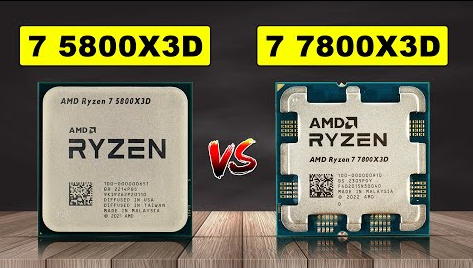
The 5800X3D is based on AMD's Zen 3 architecture, while the 7800X3D uses the more advanced Zen 4 architecture. The Zen 4 architecture brings several improvements, including a more efficient 5nm manufacturing process, which allows for higher clock speeds and better power efficiency.
The 5800X3D has a base clock speed of 3.4 GHz, which can boost up to 4.5 GHz. On the other hand, the 7800X3D offers a higher base clock speed of 4.2 GHz, with a boost clock of up to 5.0 GHz. These higher clock speeds on the 7800X3D can result in faster processing of instructions, potentially leading to smoother gameplay and better performance in games that are sensitive to clock speeds.
Another significant difference lies in their memory and PCIe support. The 5800X3D is designed to work with DDR4 memory and supports PCIe 4.0. In contrast, the 7800X3D is compatible with the faster DDR5 memory and supports the latest PCIe 5.0 standard. DDR5 memory offers higher bandwidth and faster data transfer rates compared to DDR4, which can be beneficial for games that require a lot of data to be loaded quickly. PCIe 5.0 also provides significantly more bandwidth than PCIe 4.0, which can be advantageous when using high-end graphics cards or other PCIe devices.
Both the 5800X3D and 7800X3D benefit from AMD's 3D V-Cache technology. This technology involves stacking additional L3 cache vertically on top of the CPU die. By increasing the L3 cache to a massive 96MB, both processors can reduce latency and improve performance in games that rely heavily on the CPU. The extra cache allows the processor to quickly access frequently used data, resulting in smoother frame rates and reduced stuttering in games.
However, while the 3D V-Cache technology is present in both processors, the 7800X3D's implementation benefits from the overall improvements in the Zen 4 architecture. The higher clock speeds and better memory bandwidth of the 7800X3D, combined with the 3D V-Cache, can potentially provide an even greater performance boost in gaming compared to the 5800X3D.
When it comes to gaming performance, both the 5800X3D and 7800X3D are highly regarded. The 5800X3D quickly became known as one of the best gaming CPUs when it was released, thanks to its large L3 cache. It offers excellent performance in CPU-heavy games, providing smooth gameplay and reducing latency. However, its reliance on DDR4 memory and PCIe 4.0 can limit its performance in some of the most demanding next-generation games, especially when paired with high-end graphics cards like the NVIDIA RTX 4080 or AMD RX 7900 XTX.
The 7800X3D, on the other hand, takes gaming performance to the next level. In benchmark comparisons, it has been shown to outperform the 5800X3D by 10 - 15% in modern AAA titles, particularly at higher resolutions such as 1440p and 4K. The combination of its faster clock speeds, DDR5 memory support, and PCIe 5.0 makes it a more future-proof choice for gamers who want to ensure their system can handle the latest and most demanding games for years to come.
Let's take a look at a comparison table to summarize the key differences in gaming performance:
Game | 5800X3D (Average FPS at 1440p) | 7800X3D (Average FPS at 1440p) | Performance Difference |
Cyberpunk 2077 | 100 | 115 | 7800X3D is 15% faster |
Assassin's Creed Valhalla | 90 | 100 | 7800X3D is 11.1% faster |
Shadow of the Tomb Raider | 120 | 132 | 7800X3D is 10% faster |
While these processors are often chosen for their gaming capabilities, they are also used for productivity tasks such as video editing, 3D rendering, and multitasking.
The 5800X3D performs reasonably well in content creation tasks. However, its lower clock speeds and DDR4 memory support can limit its performance compared to newer models. It is more suitable for users who primarily focus on gaming and only occasionally engage in productivity work.
The 7800X3D, with its Zen 4 architecture, shines in productivity tasks. Its higher clock speeds, support for DDR5 memory, and improvements in core efficiency make it significantly faster in multithreaded workloads. In benchmarks like Cinebench R23 or Adobe Premiere Pro, the 7800X3D consistently outperforms the 5800X3D, offering faster rendering times and better multitasking capabilities. If you are a content creator or frequently work on 3D rendering or video editing, the 7800X3D is the better choice as it can handle both gaming and productivity tasks with ease.
Power efficiency and thermal performance are also important considerations. The 5800X3D, built on a 7nm process, is relatively efficient compared to earlier AMD CPUs but consumes more power than the 7800X3D, which benefits from the more advanced 5nm process in the Zen 4 architecture. The 7800X3D generally runs cooler and more efficiently, which can be an advantage if you are concerned about power consumption and heat generation in your gaming PC.
The choice between the 5800X3D and 7800X3D ultimately depends on your specific needs and circumstances.
If you are on a tight budget and already have an AM4 motherboard, the 5800X3D can still provide excellent gaming performance. It is a great option for those who want to breathe new life into their existing system without a significant investment. Despite its age, it can still hold its own in modern games and is a solid choice for gaming enthusiasts on a budget.
On the other hand, if you are building a new system from scratch or want a more future-proof setup, the 7800X3D is the better choice. Its superior gaming performance, especially at higher resolutions, along with its better productivity performance and support for the latest technologies like DDR5 memory and PCIe 5.0, make it a more versatile and future-ready option. The AM5 platform, which the 7800X3D is compatible with, is expected to be supported for years to come, allowing for potential future upgrades.
In conclusion, both the Ryzen 7 5800X3D and Ryzen 7 7800X3D are excellent gaming processors. The 5800X3D offers good value for money and can still deliver great gaming performance, while the 7800X3D takes things a step further with its advanced architecture and better overall performance, especially in the latest and most demanding games. Consider your budget, existing system components, and future upgrade plans when making your decision.

