
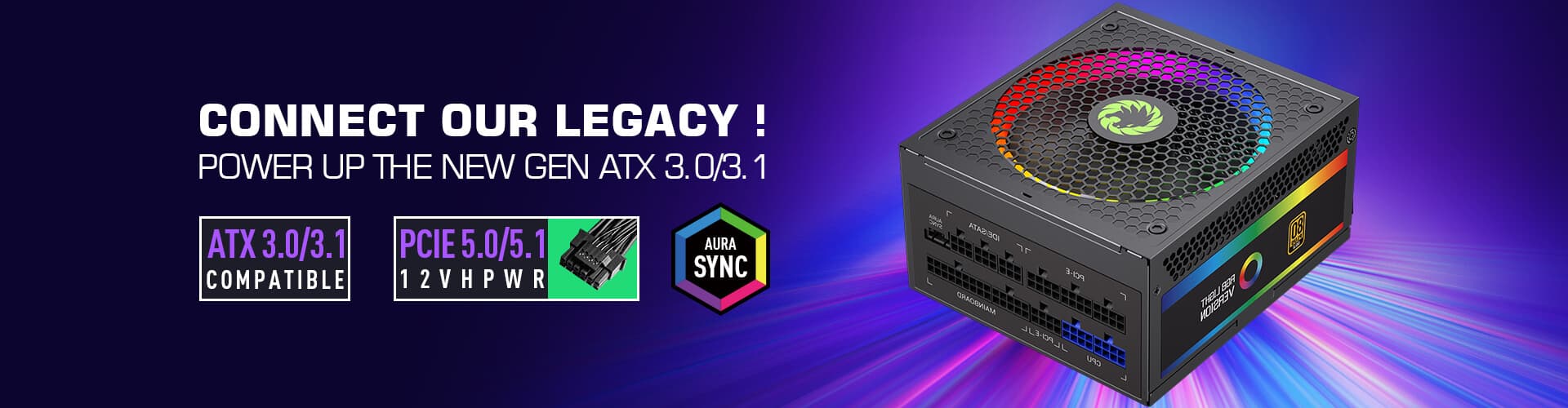
The ATX 3.0 standard, introduced in 2022, represents a pivotal shift in PC power supply design, driven by the escalating demands of modern hardware like PCIe 5.0 graphics cards and high-core-count CPUs. At its core lies the 24-pin motherboard connector, a legacy interface that has undergone subtle yet critical enhancements to meet the challenges of this new era. This article explores how the 24-pin connector navigates the delicate balance between backward compatibility and forward-looking innovation, ensuring seamless integration while supporting cutting-edge performance.
The 24-pin connector, first standardized in ATX 2.0, remains the backbone of motherboard power delivery. It distributes voltages such as +12V, +5V, and +3.3V to critical components like the CPU, RAM, and chipset . In ATX 3.0, this connector retains its physical design, ensuring compatibility with older motherboards. However, its role has evolved alongside the standard’s new requirements, particularly regarding power stability and transient response.
One of ATX 3.0’s key objectives is to maintain interoperability with existing hardware. The 24-pin connector achieves this through mechanical backward compatibility—ATX 3.0 power supplies can still connect to ATX 2.0/2.52 motherboards, and vice versa . This is crucial for users upgrading only specific components, such as replacing a GPU without overhauling the entire system. For example, a user with an ATX 2.0 motherboard can pair it with an ATX 3.0 PSU, leveraging the latter’s improved efficiency and transient response while reusing their existing board .

However, compatibility isn’t without caveats. Older motherboards may lack the power regulation capabilities required for modern GPUs, potentially limiting performance. Conversely, ATX 3.0 PSUs prioritize 12V rail stability, which might affect older components reliant on +5V or +3.3V rails . Users must ensure their legacy hardware can handle the increased 12V focus, though most modern motherboards already optimize for this .
While retaining its form factor, the 24-pin connector has undergone subtle yet significant upgrades under ATX 3.0:
The 12V rail, critical for powering CPUs and GPUs, has been optimized in ATX 3.0. Modern PSUs now deliver up to 83.3A on the 12V rail (e.g., ASUS ROG Strix 850G AURA), a 15% increase over older standards . This aligns with the power demands of CPUs like Intel’s Core i9-13900K and GPUs such as NVIDIA’s RTX 4090, which can draw over 450W under load . The 24-pin connector’s 12V pins (pins 10, 11, 21, 22, 23) are now rated for higher current, using thicker conductors and improved contact materials to reduce resistance and heat .
ATX 3.0 mandates that PSUs handle 3x the rated power for short durations (e.g., 1,350W for a 450W GPU) to stabilize power spikes during gaming or rendering . The 24-pin connector’s robust design, combined with advanced PSU circuitry, ensures it can withstand these surges without degradation. For instance, Corsair’s RM850X Shift features reinforced 12V lines and gold-plated contacts to maintain reliability under extreme loads .
To reduce electromagnetic interference (EMI) from high-frequency components, ATX 3.0 PSUs incorporate improved shielding around the 24-pin connector. This minimizes noise affecting sensitive components like RAM and USB devices, a critical factor in high-end builds where stability is paramount .
Manufacturers like Corsair and ASUS now use gold-plated pins and high-temperature-resistant plastics in 24-pin connectors. Gold plating reduces oxidation and corrosion, ensuring long-term conductivity, while durable plastics (e.g., PA66) withstand temperatures up to 125°C, crucial for PSUs operating near their thermal limits .
While ATX 3.0’s innovations address modern power needs, they introduce complexities:
Legacy Component Limitations: Older motherboards may not fully utilize the 24-pin connector’s enhanced 12V capabilities, potentially causing bottlenecks.
Adapter Reliability: Users retrofitting ATX 3.0 PSUs into older systems often rely on adapters, which can introduce resistance and heat if poorly designed .
Cost: Advanced materials and engineering increase PSU prices, making ATX 3.0 solutions more expensive than legacy alternatives.
As hardware power demands continue to rise—with rumors of 600W GPUs on the horizon—the 24-pin connector must evolve further. Potential enhancements include:
Dynamic Voltage Regulation: Real-time adjustments to 12V output based on component demands, enabled by improved communication between the PSU and motherboard.
Integrated Monitoring: Adding pins for telemetry data, allowing users to track power consumption and health via software .
Modular Design: More flexible configurations, such as detachable 12V segments for specialized builds (e.g., dual-GPU setups) .
The 24-pin connector in ATX 3.0 exemplifies the industry’s commitment to balancing compatibility and innovation. By retaining its physical form while upgrading internal design, it ensures a smooth transition for users adopting new hardware without alienating legacy systems. As PC components push power boundaries, the 24-pin connector’s adaptability will remain critical, serving as a bridge between the past and future of PC power delivery.
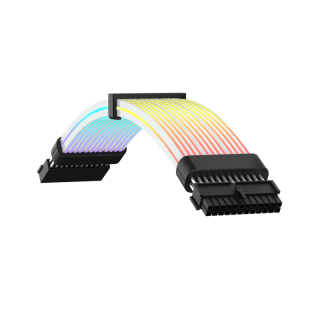
PSU extension cable, ARGB light. Description: MB 24PIN. Package: 40PCS/CTN.

