
In the PC hardware landscape, a case is not just a shell to protect components but a stage to showcase personality and technological prowess. When the transparent aesthetics of glass cases meet the hardcore cooling of mesh cases, a battle between performance and visual appeal unfolds. This article dissects their design philosophies, cooling performance, maintenance costs, noise control, and more, helping you choose the ideal case for your needs.
Tempered glass side panels have revolutionized the visual language of PC cases. Whether in full-wrap designs (e.g., the GAMEMAX N80’s 270° three-sided glass) or partial accents, glass transforms internal hardware into dynamic art through light refraction and reflection. RGB lighting, amplified by glass panels, creates immersive visual effects, making these cases a favorite among esports gamers and hardware enthusiasts.
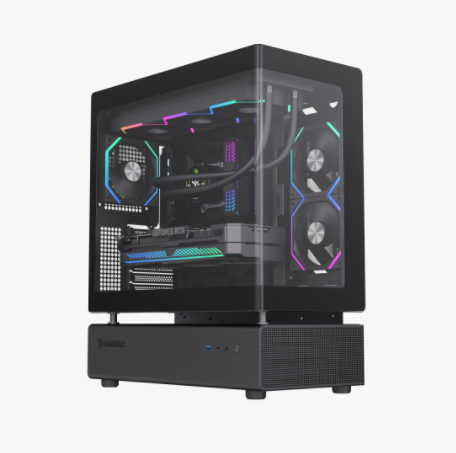
However, glass is not without flaws. It is heavier (typically 30–50% heavier than mesh cases) and physically vulnerable—while tempered glass is more impact-resistant than ordinary glass, corner collisions can still cause cracks. Additionally, glass surfaces attract fingerprints and dust, requiring regular cleaning to maintain clarity.
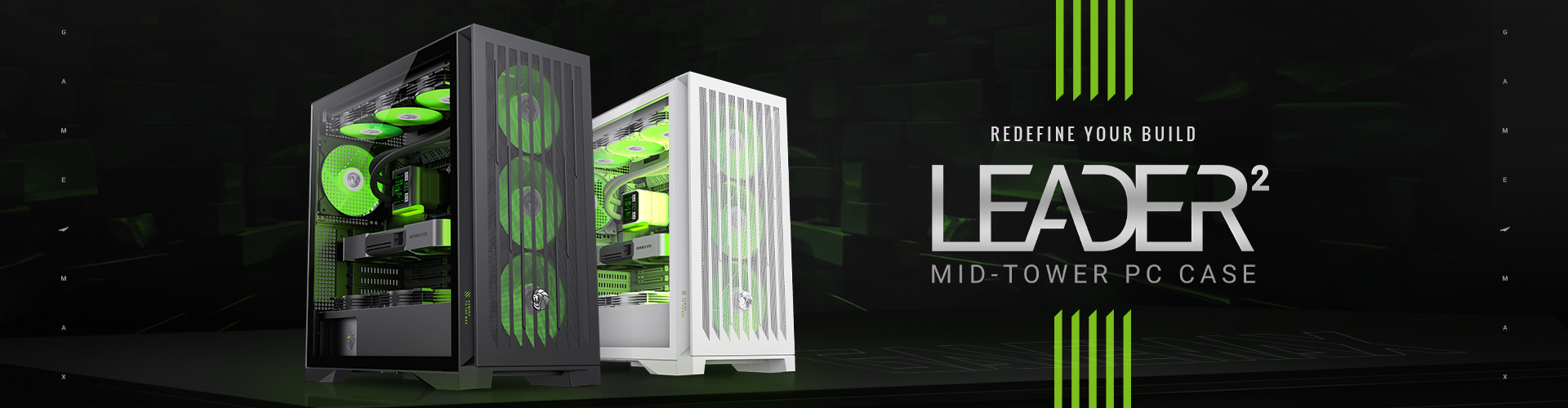
Mesh cases prioritize "aerodynamics," using large-area mesh patterns (e.g., honeycomb or hexagonal structures) to maximize airflow. This design enhances cooling efficiency while giving cases a rugged industrial style, appealing to performance-focused gamers. For example, the GAMEMAX LEADER 2 features a mesh front panel with four ARGB fans, balancing cooling and visual appeal.
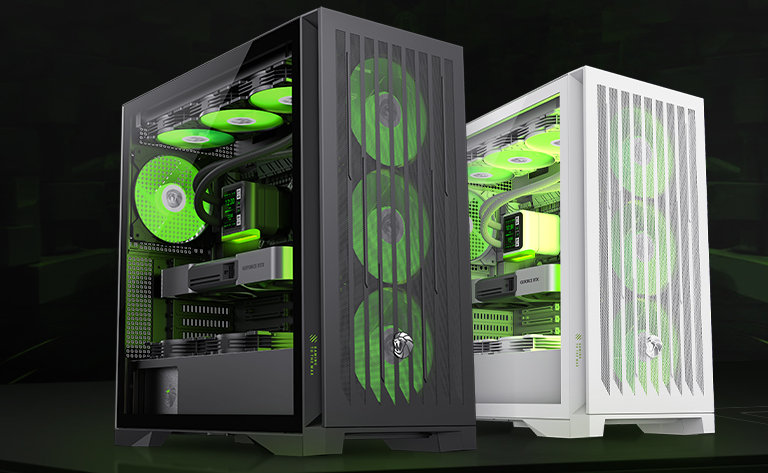
Yet, mesh designs have limitations. The exposed internal structure offers weaker hardware display, and some users find the aesthetic too rugged. Furthermore, mesh materials (metal or plastic) easily accumulate electrostatic dust, requiring more frequent maintenance.
Mesh cases excel in cooling due to their open structure. Test data shows that under heavy loads (e.g., i9-12900KF + RTX 3070 Ti dual stress test), mesh cases keep CPU core temperatures 5–8°C lower and GPU temperatures ~3°C lower than glass cases. The mesh panels allow cold air to enter directly, forming efficient airflow channels with fans to rapidly dissipate heat. For instance, the be quiet! SILENT BASE 802 sees a significant CPU temperature drop when switched to "open airflow" mode.
Glass cases’ enclosed design inherently hinders cooling. To compensate, manufacturers employ strategies like:
Optimized airflow channels: Reserved top/bottom inlets with rear fans for vertical airflow.
Enhanced fan configurations: High-end glass cases (e.g., GAMEMAX N80) support 9-fan matrices for improved airflow.
Water cooling compatibility: Support for 360mm liquid cooling radiators to manage extreme heat.
However, these measures cannot fully negate glass’s thermal drawbacks. Under extreme loads, internal temperatures in glass cases may be 10% higher than in mesh cases.
Mesh cases’ open design makes them magnets for dust. While most models include removable dust filters (e.g., be quiet!’s magnetic filters), dust seeps through mesh gaps, requiring filter cleaning every 1–2 months and deep internal cleaning quarterly. Long-term dust accumulation can slow fan speeds, reduce cooling efficiency, and even cause hardware failures.
Glass cases’ sealed design minimizes dust intrusion but is not dust-proof. Dust filters (usually at bottom/front fan intakes) need cleaning every 2–3 months. Glass panels require specialized cleaners to avoid scratches. Additionally, glass cases carry hidden long-term costs: a cracked panel can cost 30–50% of the case’s total price to replace.
Mesh cases’ open structure can increase noise levels. Tests show mesh cases may be 3–5dB louder than glass cases at full fan speed, as mesh panels do not block fan noise and airflow through mesh can cause resonance. However, premium models (e.g., Lian Li 217) optimize fan placement and use low-noise bearings to mitigate this.
Glass panels act as natural sound barriers, reducing noise by ~1.5dB in dual stress tests compared to mesh cases. Their sealed design also minimizes airflow turbulence; paired with smart fan control (e.g., ASUS Aura Sync), they can operate near-silently under low loads.
Entry-level (¥100–200): Glass cases often use acrylic (poor cooling); mesh cases offer steel durability .
Mid-range (¥200–400): Glass cases adopt tempered glass and basic water cooling support; mesh cases focus on airflow.
Flagship (¥500+): Glass cases emphasize craftsmanship (e.g., Huntkey S980 Tornado Panoramic Edition); mesh cases prioritize extreme cooling.
Personalization: Glass cases dominate the market (60% share expected in 2025) due to their aesthetics.
Eco-design: Some brands use recyclable materials (e.g., aluminum frames + recycled plastic), though environmental differences between glass and mesh remain minor.
Hybrid Models: Cases with mesh front panels and glass side panels are emerging, aiming to balance cooling and aesthetics.
Gamers/High-Performance Users: Prioritize mesh cases (e.g., GAMEMAX LEADER 2, Lian Li 217) for load stability.
Aesthetics Enthusiasts: Choose glass cases (e.g., GAMEMAX N80, Huntkey S980) to showcase RGB builds.
Noise-Sensitive Users: Pair glass cases with low-noise fans (e.g., be quiet! SILENT WINGS 3) for quiet operation.
Budget-Consistent: Entry-level mesh cases (e.g., Segotep SG-950R) offer cooling at a lower cost.
The choice between glass and mesh cases boils down to balancing performance, aesthetics, and practicality. Mesh cases cater to performance-focused users with the cooling and value, while glass cases win over aesthetes with their visual appeal and silence. As technology evolves, the line between them blurs—future "hybrid" cases may seamlessly merge transparency and cooling. Until then, choose based on your needs and preferences to craft your ideal PC setup.
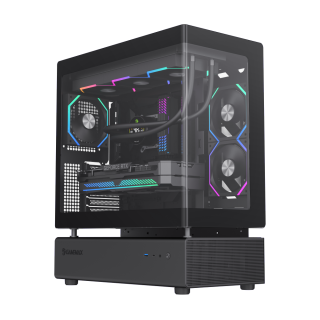
• Detachable modular design
• Integrated wraparound glass panel
• Internal panorama view
• 270° cooling with 6 ARGB fans
• Customizable ARGB sync
• Vertical GPU mount
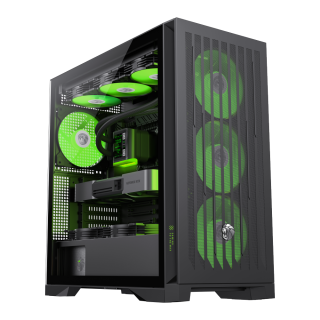
• Comprehensive Compatibility: Supports E-ATX motherboards, 425mm GPUs, 420mm radiators, 245mm PSUs, and 185mm air coolers for versatile hardware configurations.
• Advanced Cooling Matrix: Offers 9×120mm or 8×140mm fan mounts with 4 pre-installed 140mm ARGB PWM fans and a dedicated controller.
• Future-Proof Connectivity: Features Type-C Gen 2, dual USB 3.0 ports, and BTF motherboard compatibility for modern cable management.
• Effortless Building: Incorporates a tool-free design, vertical GPU support, and hidden cable routing with a detachable cover.
• Lion-Inspired Design: Showcases bold claw-mark mesh panels, a tempered glass side panel, and customizable ARGB lighting.

