
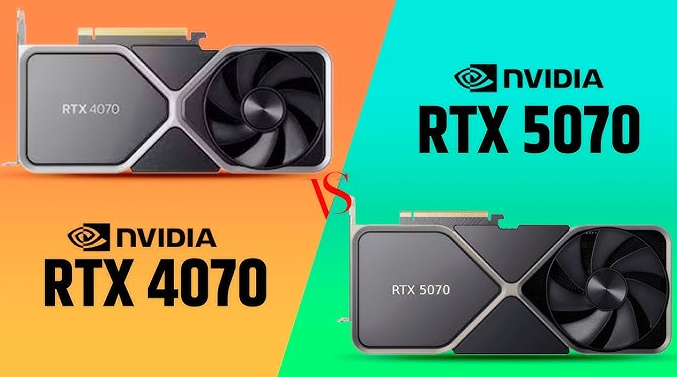
When it comes to mid - range graphics cards, the NVIDIA GeForce RTX 5070 and RTX 4070 are two prominent options that attract a lot of attention. To help you clearly understand their differences, we'll first present a key parameter comparison table, and then conduct a detailed analysis based on it.
Comparison Item | RTX 5070 | RTX 4070 |
Manufacturing Process | TMSC 5nm | TMSC 5nm |
Base Clock | 2325 MHz | 1920 MHz |
Boost Clock | 2512 MHz | 2475 MHz |
VRAM Capacity | 12GB | 12GB |
VRAM Type | GDDR7 | GDDR6X |
TDP | 250W | 200W |
Supported Technologies | DLSS 4, PCIe Gen 5 | DLSS 3, PCIe Gen 4 |
1440P Gaming Average FPS Advantage | Leading by 13%-35.6% overall (varies by game) | - |
1% Low FPS Advantage | Leading by 14.4%-21.8% overall (varies by game) | - |
3DMark Time Spy Improvement | Better than RTX 4070 (specific improvement[X]%) | - |
LuxMark Ray Tracing Improvement | Better than RTX 4070 (specific improvement[X]%) | - |
Compute Mark Improvement | Better than RTX 4070 (specific improvement[X]%) | - |
Power Efficiency in Gaming Scenarios | - | 13% higher than RTX 5070 |
Power Efficiency in Ray Tracing Scenarios | - | The efficiency advantage further expands (specific gap not clear) |
Both the RTX 5070 and RTX 4070 are built on TMSC's 5nm process node. This means they share the same fundamental manufacturing technology, but there are still obvious differences in other architectural aspects.
In terms of clock speeds, the RTX 5070 has a significant lead. Its base clock speed is 2325 MHz, which is much higher than the RTX 4070's 1920 MHz. Even in boost clock, the RTX 5070's 2512 MHz is slightly higher than the RTX 4070's 2475 MHz. Higher clock speeds allow the RTX 5070 to process data faster, which is very beneficial for improving performance in gaming and various computing tasks.
When it comes to VRAM, both cards have 12GB capacity, which can meet the needs of most 1440p gaming and productivity work. However, the VRAM type is different. The RTX 5070 uses GDDR7, while the RTX 4070 uses GDDR6X. GDDR7 has a higher data transfer rate, which can effectively enhance memory bandwidth. This enables the RTX 5070 to handle large - volume data transmission between the GPU and memory more efficiently, such as in games with high - definition textures and complex 3D models in content creation.
At 1440p resolution with maximum settings, the RTX 5070 outperforms the RTX 4070 in various games. In "Marvel Rivals", the RTX 5070 has an average frame rate of 78 fps, 13.7% higher than the RTX 4070's 68 fps, and the 1% low frame rate is also 14.4% higher. In "Hogwarts Legacy", the leading advantage is even more obvious, with the average frame rate of the RTX 5070 being 35.6% higher than that of the RTX 4070. Such a performance gap makes the RTX 5070 more able to provide a smooth and immersive gaming experience.
In productivity - related benchmarks, the RTX 5070 also shows better performance. In the 3DMark Time Spy Graphics test, which reflects DirectX 12 - based 3D application performance, the RTX 5070 scores higher. In LuxMark v2.0 Sala GPU, which focuses on GPU - accelerated ray tracing, the RTX 5070 can complete tasks faster. In the Compute Mark v2.1 test that evaluates general computing performance, the RTX 5070 also has a certain lead. These results indicate that the RTX 5070 is more competent in 3D rendering, video editing and other productivity tasks.
The TDP of the RTX 4070 is 200W, while that of the RTX 5070 is 250W. This shows that the RTX 4070 is more power - efficient. In gaming scenarios, the RTX 4070 is 13% more power - efficient than the RTX 5070. When ray tracing is enabled, the power efficiency advantage of the RTX 4070 is further expanded. Lower power consumption not only helps reduce electricity bills but also reduces heat generation, which is beneficial to the cooling of the whole system, especially for small - sized cases.
The RTX 5070 supports the latest DLSS 4 technology, while the RTX 4070 only supports DLSS 3. DLSS 4 has more advanced super - sampling algorithms, which can upscale the game from a lower resolution to a higher resolution while maintaining or even improving the image quality, thus greatly improving the frame rate. In addition, the RTX 5070 supports PCIe Gen 5, which has a higher data transmission speed than the PCIe Gen 4 supported by the RTX 4070, laying a good foundation for better cooperation with the latest motherboards and other hardware.
The initial price of the RTX 5070 is about $303 lower than that of the RTX 4070, but the price may fluctuate with market changes. If you pay more attention to performance and want to enjoy the latest technologies, and your power supply can meet the 250W power requirement of the RTX 5070, then the RTX 5070 is a better choice. If you are sensitive to power consumption and budget, and the performance of the RTX 4070 can meet your needs, then the RTX 4070 is more cost - effective.
For users who already own an RTX 4070, upgrading to the RTX 5070 may not be very cost - effective, especially if the price gap widens. However, if you are building a new computer or upgrading from older graphics cards such as the 2070 or 3070 series, the RTX 5070 can bring a significant performance improvement.

