
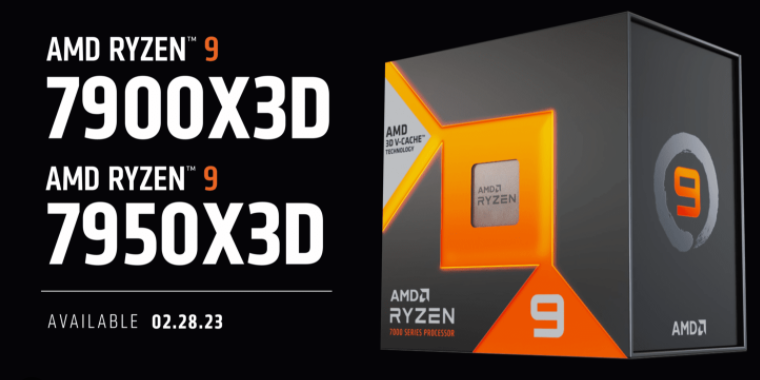
In the dynamic world of PC hardware, AMD's Ryzen processors have occupied an important position. Among the latest products, the AMD 7800X3D and 7950X3D stand out, each with its own characteristics, performance, and price positioning. This article will conduct a comprehensive analysis of these two processors, exploring their differences in price, performance under different workloads, and the scenarios where each is most applicable.
Parameter | AMD 7800X3D | AMD 7950X3D |
Price | Approximately $450 | Listed price \(700, market price \)800 - $850 |
Cores/Threads | 8 cores 16 threads | 16 cores 32 threads |
Maximum Boost Clock | 5 GHz | 5.7 GHz |
Total L2 and L3 Cache | 100 MB | 144 MB |
TDP | 120W | 120W |
In terms of cost, the AMD 7800X3D and 7950X3D are in different price ranges. The AMD 7800X3D is usually priced at around $450, providing a more economical choice for hardware enthusiasts. This price point is very attractive for those who want to build a high-performance gaming rig without spending too much.
On the other hand, the AMD 7950X3D has a high premium with a listed price of \(700, and its market price is often between \)800 and \(850. The significant price difference of about \)300 - $400 between the two processors makes the 7800X3D more acceptable to many consumers.
The AMD 7950X3D has 16 cores and 32 threads. Its high core count makes it an ideal choice for applications that can make full use of multi-threading. Tasks such as video editing, 3D rendering, and complex data processing are where the 7950X3D excels.
In contrast, the AMD 7800X3D has 8 cores and 16 threads. Although it seems to have slightly weaker performance, it has its own unique advantages, especially in gaming, which we will discuss further.
The AMD 7950X3D can be boosted to an amazing 5.7 GHz, having a significant advantage in clock speed. This high clock speed can make the single-core performance of some applications faster. The maximum boost clock of the AMD 7800X3D is 5 GHz. Although it is still fast, the higher clock speed of the 7950X3D may have an impact on tasks that rely on single-core performance.
Both processors adopt AMD's innovative 3D V - Cache technology, which greatly improves performance. The total L2 and L3 cache of the 7950X3D is 144 MB, while that of the 7800X3D is 100 MB. The larger cache of the 7950X3D may benefit applications that need to store a large amount of data near the CPU for quick access. However, in most actual games and general applications, the difference in cache size may not be so obvious.
In the field of gaming, the AMD 7800X3D performs excellently. Despite having fewer cores and a slightly lower clock speed, it often outperforms the 7950X3D in gaming benchmarks. The 3D V - Cache technology in the 7800X3D locates game code in the large L3 cache, reducing latency and memory access time. This makes the gameplay of many popular games smoother and with higher frame rates.
For example, in games such as "Cyberpunk 2077" and "Dying Light 2", the 7800X3D has a higher average frame rate. In "Cyberpunk 2077", although the power consumption of the 7950X3D is 20% higher, its average package temperature is the same as that of the 7800X3D, and the average speed of the 7800X3D is faster. In "Dying Light 2", the 7950X3D consumes more power, but its heat dissipation is almost the same as that of the 7800X3D, and the 7800X3D encounters fewer CPU - bound scenarios.
In terms of productivity tasks, the high core count of the 7950X3D gives it an obvious advantage. In applications such as Cinebench, which measures multi-core performance, the score of the 7950X3D is almost twice that of the 7800X3D. Blender, Handbrake, and 7 - zip also benefit a lot from the 16 - core configuration of the 7950X3D, enabling it to complete tasks much faster.
However, things are not one-sided. In some web - based benchmarks, such as Jetstream, which tests 64 browser - based applications, the performance gap between the two processors is only about 9%. In Pugetbench for Photoshop, both processors have almost the same scores, which are more than 50% higher than those of the previous generation products.
In terms of power consumption, both processors are relatively efficient. The TDP of the AMD 7800X3D is 120W, and the TDP of the 7950X3D is also 120W. However, in gaming workloads, the 7800X3D has been shown to be more energy-efficient, as it can achieve the same or better gaming performance while consuming less power.
Regarding heat dissipation, although the 7950X3D consumes more power in some scenarios, its average package temperature is similar to that of the 7800X3D. This may be due to AMD's efficient cooling and heat dissipation management technologies in both processors.
If you are mainly a gamer and want the best gaming performance at a more reasonable price, then the AMD 7800X3D is undoubtedly the winner. It provides excellent gaming performance, high energy efficiency, and much lower cost.
However, if you are a content creator or professional who often deals with multi-threaded tasks such as video editing, 3D rendering, or complex data analysis, the high core count and larger cache of the AMD 7950X3D will bring significant performance improvements.
In conclusion, both the AMD 7800X3D and 7950X3D are excellent processors, but the choice between them depends on your specific needs, budget, and the types of tasks you perform most frequently.

