
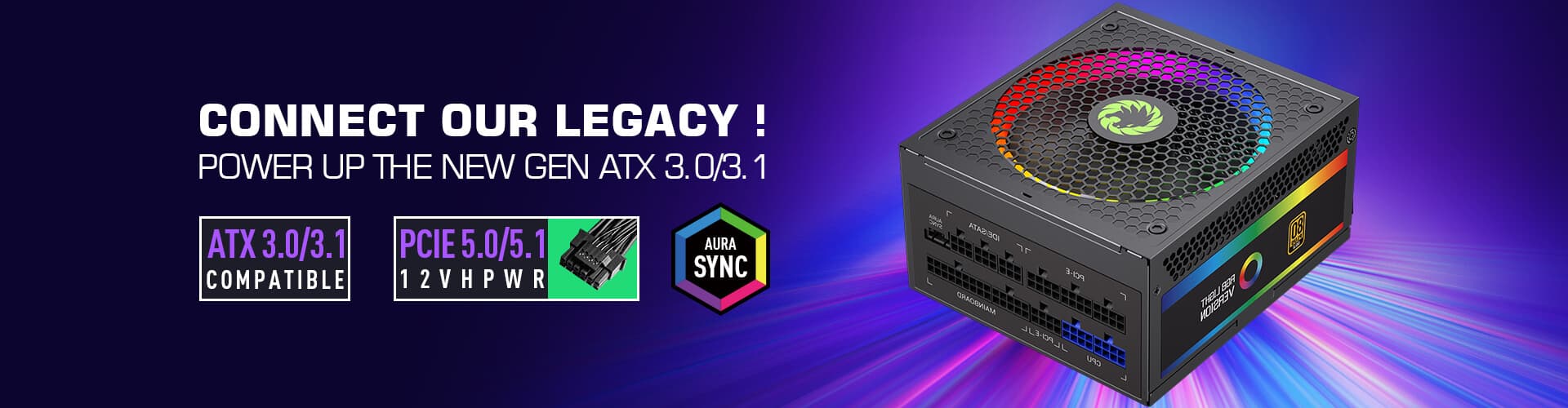
With the launch of NVIDIA's RTX 50 series and AMD's Radeon RX 9000 series graphics cards, it has become the norm for GPUs to have a power consumption exceeding 600W. Traditional 8-pin interfaces (with a maximum of 150W per port) can no longer meet the requirements. The 16-pin power connector (12V - 2x6) ready for PCIe 5.1, with its single - port power supply capacity of 600W and in - depth synergy with PCIe 5.1, has become the core power supply solution for high - performance GPUs. This article will conduct an in - depth analysis from four dimensions: technological innovation, market applications, compatibility upgrades, and future trends to help you comprehensively understand this crucial hardware.
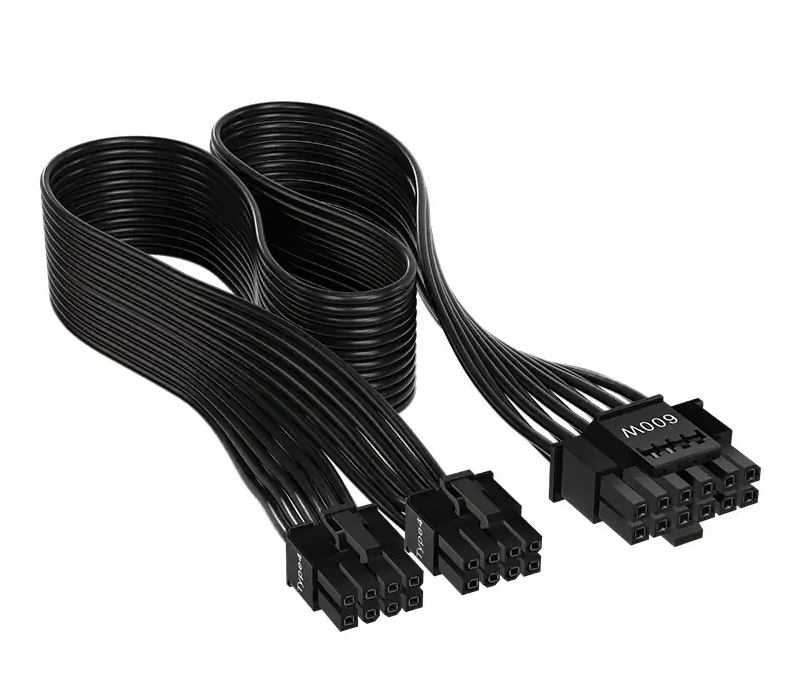
Pin Design: The 16 - pin connector features a 12 + 4 - pin layout. Among them, 12 pins are responsible for power supply (6 pairs of 12V wires), and 4 pins are used for signal transmission (such as current monitoring and temperature feedback).
Anti - Misplugging Mechanism: The unique L - shaped notch design prevents reverse insertion. The revised 12V - 2x6 standard (CEM 5.1) further optimizes the pin structure, ensuring that the signal pins only make contact after the power pins are fully inserted, fundamentally solving the overheating problem caused by loose connections in the early 12VHPWR interfaces.
Current - Carrying Capacity: Each pin supports a current of 9.2A, and the upper limit of the bus current is increased to 55A. When paired with 16AWG or thicker wires, it can reduce resistance loss (for example, a 16AWG wire diameter can support a 50A current).
Dynamic Power Management: PCIe 5.1 introduces built - in error - correcting code (ECC) and enhanced signal integrity technologies. The 16 - pin connector interacts with the GPU in real - time through 4 signal pins to dynamically adjust the power supply strategy and reduce instantaneous power fluctuations (for example, the instantaneous power consumption of the RTX 5090 can reach 1200W).
Energy Efficiency Optimization: The single - rail 12V design reduces voltage conversion loss, with an efficiency improvement of about 3%. It also supports the enhanced hot - plug function of PCIe 5.1, ensuring stability under high loads.
Stringent Process Requirements: The 12V - 2x6 connector needs to pass a 30°C temperature rise test and uses processes such as crimping, mechanical fixing, and welding to avoid current imbalance caused by poor wire quality.
Safety Certification: Power supplies that comply with the ATX 3.1 standard (such as the MSI MPG A1250GS) support a 2 - fold total power deviation and a 3 - fold instantaneous GPU power deviation, ensuring reliability under extreme loads.
Flagship Graphics Card Compatibility: Graphics cards such as the NVIDIA RTX 5090 (600W) and AMD Radeon RX 9900 XT (550W) require a 16 - pin interface to avoid the risks associated with parallel connection of multiple 8 - pin wires. Single - interface power supply simplifies the cable management inside the chassis.
8K Rendering and AI Training: Long - term high - load tasks have strict requirements for power supply stability. The 16 - pin connector supports real - time temperature monitoring and overload protection, reducing the risk of wire overheating.
Multi - GPU Clusters: Accelerator cards such as the NVIDIA H100 require high - density power supply. The 16 - pin interface saves chassis space and supports liquid - cooling system adaptation (such as the liquid - cooling module of the MSI MPG A1250GL).
Edge Computing and In - Vehicle GPUs: The automotive - grade 16 - pin connector (such as the Tesla FSD chip) supports high - reliability power supply and can adapt to complex environments.
Dual 16 - pin Design: Graphics cards such as the GALAX RTX 5090D HOF adopt a dual 16 - pin interface, supporting a peak power consumption of 1200W, specifically designed for overclocking enthusiasts.
Third - Party Custom Cables: Products such as the CableMod Pro series support personalized color matching and are certified by CEM 5.1 to ensure electrical performance.
ATX 3.1 Power Supplies: Such as the MSI MPG A1250GS and Gigabyte Aorus Elite series, which natively support the 16 - pin interface, are recommended for use with the RTX 50 series graphics cards.
Upgrading Old Power Supplies: An adapter (such as the NZXT PA - xG1BB) can be used to convert from 12V - 2x6 to 8 - pin to make the power supply compatible with ATX 2.x power supplies. However, attention should be paid to the power limit of the adapter (usually 600W).
Original Modular Cables: Brands like Corsair's RM series and Seasonic's PRIME TX - 1000 provide native 16 - pin cables, ensuring compliance with the CEM 5.1 standard.
Third - Party Custom Cables: For example, the EZDIY - FAB's 180 - degree right - angle adapter uses an aluminum heat - dissipation shell and a 4 - layer PCB design, supporting 600W of power and reducing the bending stress of the cables.
Loose Connection Risk: Choose cables with indicator lights (such as the MSI dual - color 16 - pin cable) to ensure that the interface is fully inserted.
Temperature Monitoring: Some adapters developed by domestic players support real - time current monitoring to avoid overloading.
Gallium Nitride (GaN) Technology: Future power supplies may use GaN components to further reduce the size and increase the power density (such as the DC - DC circuit design of the MSI MPG A1250GL).
AI - Powered Power Management: The power supply and the graphics card will work together through the 16 - pin signal pins to dynamically adjust the power consumption curve and reduce peak loads (such as the intelligent power distribution of NVIDIA DLSS 4).
Portable Workstations: The 16 - pin interface supporting the PD protocol may be integrated into laptops to enable efficient power supply for external graphics card docks (such as the Razer Core X Pro).
Blockchain and Mining Machines: In response to the high - power consumption requirements of cryptocurrency mining, the 16 - pin interface may become the standard for mining machines.
Firmware Upgrade Support: Future graphics cards and power supplies may be able to adapt to new features of PCIe 5.1 through firmware updates (such as the BIOS update of the MSI MPG A1250GS).
Fault Diagnosis System: The 16 - pin connector may integrate a fault diagnosis chip to provide real - time feedback on the interface status and improve system stability.
Q: What is the difference between the PCIe 5.1 Ready 16 - pin connector and the old 12VHPWR?
A: The new 12V - 2x6 connector optimizes the pin structure, ensuring that the signal pins only make contact after the power pins are fully inserted. It also increases the current - carrying capacity to 55A, solving the overheating problem of the early interfaces.
Q: Do I need to replace the power supply?
A: If the graphics card's power consumption is ≥600W, it is recommended to upgrade to an ATX 3.1 power supply. If using an adapter, ensure that the 12V output capacity of the power supply is ≥600W.
Q: Are existing 16 - pin cables compatible with PCIe 5.1?
A: It is necessary to confirm whether the cables meet the CEM 5.1 standard (such as being marked with the "H++" logo). Old 12VHPWR cables may pose safety risks.
Q: Will future graphics cards fully adopt the 16 - pin interface?
A: Yes, the next - generation flagship graphics cards from NVIDIA and AMD will fully adopt the 16 - pin interface, and older 8 - pin graphics cards may be gradually phased out.
The PCIe 5.1 Ready 16 - pin power connector is a crucial part of the evolution of GPU technology. Its efficient power supply capacity provides a foundation for next - generation hardware. Users need to pay attention to interface compatibility, cable quality, and safety hazards, and choose power supplies and graphics cards that natively support ATX 3.1 and CEM 5.1. With technological iterations, the 16 - pin connector will drive PC hardware towards higher performance and lower energy consumption, becoming a core component of high - performance computing in the next decade.
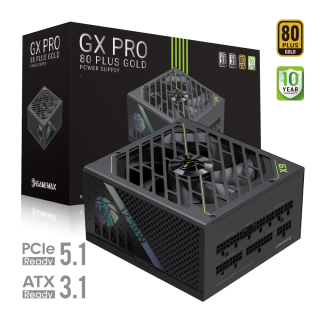
GX PRO 1250G 80 Plus Gold Modular Power Supply: ATX3.1 Ready, Silent Cooling, & Premium Durability
• 80 Plus Gold Efficiency & Quiet Operation: Achieves 90% efficiency under typical loads with APFC+LLC+DC-DC design, minimizing power waste and noise.
• Premium Durability & Reliability: Built with Japanese 105°C capacitors and solid capacitors for long-term stability and performance.
• ATX3.1 & PCIe5.1 Ready: Features a native 12V-2x6 connector for seamless RTX 40/50 GPU compatibility and efficient power delivery.
• Advanced Thermal Management: 13.5cm FDB fan with intelligent temperature control ensures quiet cooling and optimal heat dissipation.
• Modular Design & Robust Protection: Fully modular layout with dual-stage EMI filtering and NTC thermistor safeguards against surges, while gold-plated cables ensure durable, high-conductivity connections.

