
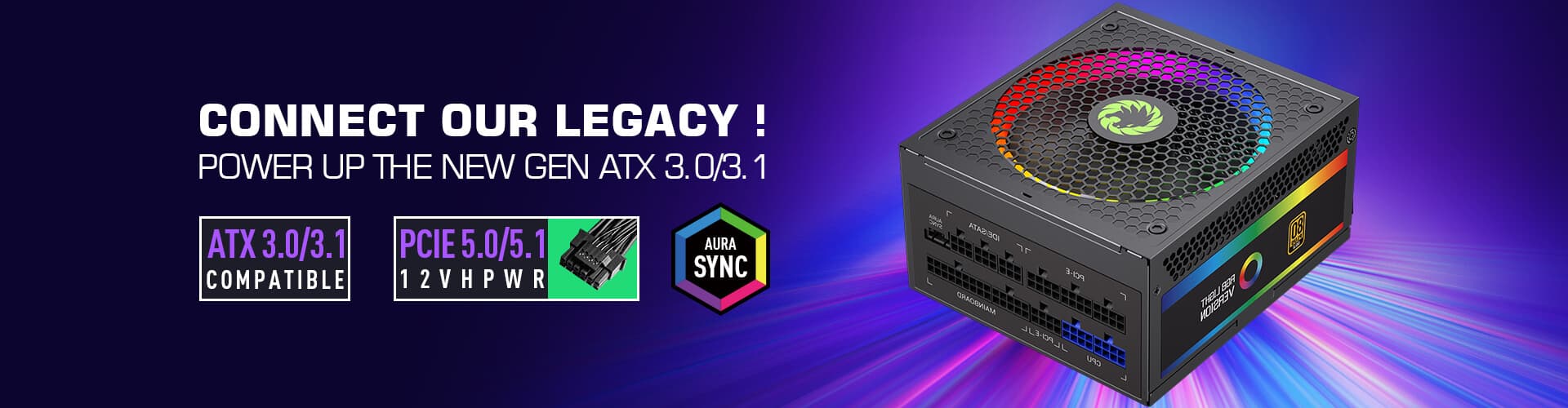
Definition: The maximum power a power supply can deliver continuously under standard conditions (25°C ambient temperature, 100-240V input voltage), measured in watts (W).
Technical Insights:
Designed to meet INTEL ATX standards, ensuring safe current limits for +5V, +3.3V, and +12V output rails.
Real-world output may decrease by 10-15% in high-temperature environments (e.g., summer use).
High-quality units often exceed rated power by 50-80W temporarily due to superior components and craftsmanship.
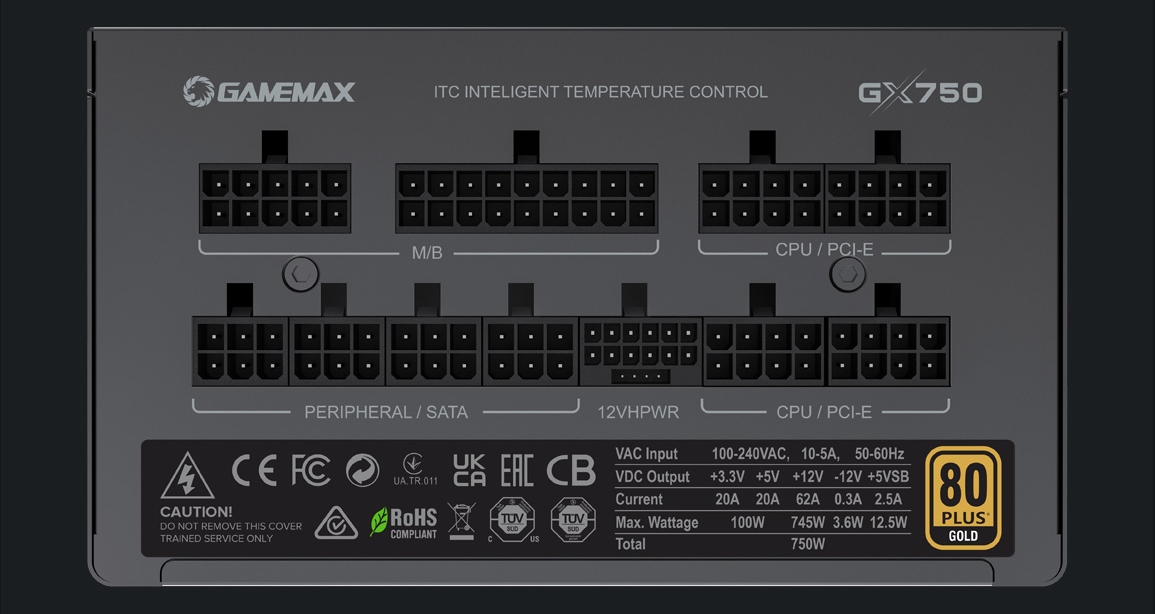
Definition: The maximum power a supply can briefly produce (typically under 30 seconds), usually 1.5-2x the rated power.
Key Limitations:
Only intended for transient loads during hardware startup (e.g., hard drives drawing 3-5x normal current at boot).
Prolonged operation at peak power risks overheating, component failure, or fire hazards.
Some manufacturers misuse terms like "Maximum Power" to mislead, with actual peak durations as short as a few seconds.
| Criteria | Rated Power | Peak Power |
|---|---|---|
| Operation Time | 24/7 stable output | <30 seconds transient support |
| Voltage Stability | Voltage fluctuations ≤5% | Fluctuations may exceed 10% |
| Industry Standards | Compliant with ATX specifications | No universal standard |
| Safety Margin | 20-30% built-in buffer | No long-term safety reserve |
| Energy Impact | Directly affects long-term energy costs | Irrelevant for efficiency |
Component Power Breakdown (Example for Gaming/Workstations):
CPU: Intel i9-13900K (253W), AMD Ryzen 9 7950X (170W)
GPU: NVIDIA RTX 4090 (450W), AMD RX 7900 XTX (355W)
Peripherals: Motherboard (25W) + RAM (15W) + Storage (10W) + Cooling (5W)
Formula: Total Power = (CPU + GPU) × 1.3 + Peripherals
Example: RTX 4090 + i9-13900K = (450+253)×1.3 + 55 ≈ 1,050W → Opt for a 1,200W rated supply.
80 PLUS Standards:
Gold: ≥90% efficiency at 50% load, ≥87% at 100% load (ideal for mid-to-high-end builds).
Titanium: ≥94% efficiency at 50% load (premium choice for low energy costs).
New GB 20943-2025 Standard (China):
Mandatory by 2027, aligning with EU CoC and US DoE tests, ensuring global compatibility.
Advantages: 500kHz+ switching frequency, 3x higher power density than traditional designs.
Example: Huntkey WD750Evo (GaN + Full-Bridge LLC Topology, 92% efficiency).
Fully Modular: Customizable cabling for better airflow and aesthetics (e.g., be quiet! Dark Power Pro 12 1200W).
Semi-Modular: Fixed essential cables with optional add-ons (cost-effective, e.g., Great Wall G7 750W).
Build: RTX 4090 + i9-13900K + 32GB DDR5 + Dual NVMe SSDs
Power Choice: 1,200W+ rated (e.g., ASUS ROG Thor II 1600W, Titanium-certified with 16Pin 12VHPWR).
Key Features: 14cm FDB fan with auto-stop for silent operation.
PSU CALCULATOR:https://gamemaxpc.com/power-supply-calculator/

Build: RTX 6000 Ada + AMD Threadripper PRO 5975WX + 128GB ECC RAM
Power Choice: 1,600W+ rated (e.g., Seasonic PRIME TX-1600, LLC + DC-DC topology for ≤15mV ripple noise).
Build: RTX 4070 Ti + i5-13600K + 16GB DDR5 + Single NVMe SSD
Power Choice: 650W+ SFX/SFX-L (e.g., ASUS ROG LOKI 850P, 100mm size for Lian Li TU150 compatibility).
Label Checks: Insist on clear "Rated Power" labeling (font ≥4mm). Avoid units listing only "Peak Power" or "Max Power".
Weight Test: A genuine 650W supply weighs ≥1.5kg. Lightweight units (≤1.2kg) may use subpar components or fake weights (e.g., cement fillers).
Top Brands: GAMEMAX、Cooler Master、Corsair
Warranty Standards:
Mid-range: 5-year coverage (e.g., Xigmatek Gold 750W).
Flagships: 10-year warranties (e.g., Corsair AX1600i).
Silicon Carbide (SiC): 1.7kV voltage tolerance, ideal for server-grade power supplies.
GaN Evolution: Reducing size while increasing efficiency to 95%+ for consumer units.
Digital Control: MCUs enable real-time load adjustment (e.g., Seasonic FOCUS GX-850 with APP monitoring).
Liquid Cooling Integration: Low-noise solutions like MSI MPG A1000G (≤15dB with water cooling).
Prioritize Rated Power: Base your choice on 1.3-1.5x your system’s total calculated load (1.5x for overclocking/enthusiast setups).
Check Certifications: 80 PLUS Gold/Titanium for efficiency; ensure compliance with regional standards (e.g., GB 2025 for China).
Balance Features: Modular designs for cable management, GaN/SiC for compactness, and long warranties for peace of mind.
By focusing on rated power stability over flashy peak specs and leveraging technical advancements, you’ll ensure your system runs reliably, efficiently, and safely—whether for gaming, professional workloads, or everyday use.

