
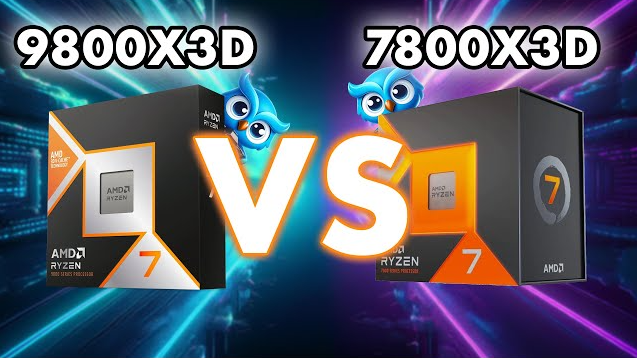
When it comes to high-performance processors for gaming and productivity, AMD's 3D V-Cache-equipped Ryzen chips have set the bar for excellence. The Ryzen 7 7800X3D and its successor, the Ryzen 7 9800X3D, represent two generations of AMD's gaming-focused processors, each bringing unique advantages to the table. This comprehensive comparison will help you determine which chip best fits your needs, whether you're building a new system or upgrading an existing one.
At the core of these processors lies a significant architectural jump. The 7800X3D, released in January 2023, utilizes AMD's Zen 4 architecture built on TSMC's 5nm process. In contrast, the 9800X3D (launched November 2024) features the newer Zen 5 architecture on a more advanced 4nm process, delivering improved efficiency and performance.headlines
This generational leap translates to several key improvements:
Increased IPC (Instructions Per Cycle): Zen 5 architecture provides approximately 10-15% better IPC compared to Zen 4
Enhanced 3D V-Cache implementation: The 9800X3D uses a revised cache stacking method, placing V-Cache under the chiplet rather than on top for better thermal management
Improved power efficiency: Despite higher clocks, the 9800X3D maintains reasonable temperatures under load
While both processors share the same 8-core, 16-thread configuration that has proven ideal for gaming, there are critical differences in their specifications:
Specification | Ryzen 7 7800X3D | Ryzen 7 9800X3D |
Base Clock | 4.2 GHz | 4.7 GHz (+0.5 GHz) |
Boost Clock | 5.0 GHz | 5.2 GHz (+0.2 GHz) |
Total Cache | 104MB (8MB L2 + 96MB L3) | 104MB (8MB L2 + 96MB L3) |
TDP | 105W | 120W (+15W) |
Process | TSMC 5nm | TSMC 4nm |
Memory Support | DDR5-5200 | DDR5-5600 |
Max Temperature | 89°C | 95°C |
Data compiled from [1,4,5]
The 9800X3D's higher base clock (4.7GHz vs 4.2GHz) represents a more significant improvement than the modest boost clock increase, as sustained performance in games often relies more on base frequencies. Additionally, the move to 4nm 工艺 allows these higher clocks to be maintained more efficiently.
In gaming scenarios, the 9800X3D delivers consistent improvements over its predecessor, though the extent varies by title:
Average frame rate increases range from 3.5% in God of War (373 FPS vs 386 FPS) to a substantial 27.6% in The Witcher 3 (94 FPS vs 120 FPS)
Minimum frame rates show similar improvements, crucial for smooth gameplay experience
CPU utilization remains efficient in both processors, with neither hitting bottleneck levels in tested configurations
Notably, the 9800X3D achieves these gains while maintaining lower operating temperatures (5-11°C cooler) despite its higher TDP, thanks to improved architecture and thermal design. This makes it more forgiving of mid-range cooling solutions.
The largest performance leaps occur in CPU-bound scenarios like The Witcher 3 and Microsoft Flight Simulator, where the 9800X3D's architectural improvements and higher clocks provide significant advantages. In GPU-limited situations (e.g., Cyberpunk 2077 at 1080p max settings with RTX 4090), the gains are more modest but still measurable.
While both processors are primarily gaming-focused, the 9800X3D shows substantial improvements in productivity workloads:
22% faster single-threaded performance in Geekbench 6 (3305 vs 2700)
20-23% higher multi-threaded scores in the same benchmark (18,221 vs 15,000)
34% improvement in multi-threaded productivity tasks compared to 7800X3D, according to Tom's Hardware testing
These gains stem from several factors:
Zen 5's IPC improvements
Higher sustained clock speeds
Better cache utilization
Improved memory controller efficiency with DDR5-5600 support
However, it's important to note that Intel's competing processors still hold an edge in multi-threaded performance, with the Core i9-14900K and Ultra 9 285K delivering 41% and 64% higher threaded performance respectively. This positions the 9800X3D as a better all-rounder than its predecessor but still primarily optimized for gaming.
A significant departure from previous X3D models is the 9800X3D's unlocked multiplier, allowing for manual overclocking – a first for AMD's 3D V-Cache processors. Early tests show promising results:
All-core overclocks reaching 5.6GHz
Stable performance with proper cooling
360mm AIO coolers maintaining temperatures around 84°C at 133W power consumption
In contrast, the 7800X3D remains locked and limited to AMD's Precision Boost Overdrive for performance tuning.
The 9800X3D's revised thermal design (with V-Cache moved below the chiplet) pays dividends in temperature management. Even at higher power levels, it maintains lower operating temperatures than the 7800X3D under similar loads – a surprising result given its higher TDP and clockspeed.
Both processors use AMD's AM5 socket, offering a degree of future-proofing:
The 7800X3D works with X670, B650, and A620 motherboards with appropriate BIOS updates
The 9800X3D is compatible with the same chipsets but may require newer BIOS versions, especially on older motherboards
Both support PCIe 5.0 and DDR5 memory, though the 9800X3D officially supports higher memory speeds
For existing AM5 users, upgrading from 7800X3D to 9800X3D avoids the need for a new motherboard, reducing upgrade costs. However, new builders should consider that the 9800X3D's higher power requirements may necessitate a slightly better power supply (650W minimum recommended vs 600W for 7800X3D).
At a $30 premium over the 7800X3D's launch price, the 9800X3D delivers meaningful improvements that justify the cost for certain users:
For competitive gamers chasing every possible frame, the 3-27% performance gains, particularly in minimum frame rates, can provide a tangible advantage
Content creators who game heavily will appreciate the 20-34% productivity improvements
Future-proofing enthusiasts will value the newer architecture and overclocking capabilities
However, the 7800X3D remains an excellent value proposition, especially as its price has likely decreased since launch. For 1440p or 4K gamers using mid-range GPUs (RTX 4070 or RX 7900 XT), the performance difference between these processors will be less noticeable than at 1080p with high-end GPUs.
The Ryzen 7 9800X3D represents a meaningful upgrade over the 7800X3D, with its Zen 5 architecture, higher clocks, better thermals, and overclocking capabilities delivering improved gaming and productivity performance. It's the clear choice for:
Enthusiasts building a new high-end gaming PC
Competitive gamers targeting 1080p or high-refresh 1440p gaming
Users who want the best possible AM5 processor with room to overclock
Meanwhile, the Ryzen 7 7800X3D remains a compelling option for:
Budget-conscious builders who still want excellent gaming performance
1440p/4K gamers where GPU performance is the primary bottleneck
Users with existing AM5 systems looking for a more affordable upgrade
Ultimately, both processors represent AMD's commitment to gaming performance, with the 9800X3D refining an already excellent formula into something even better – while the 7800X3D continues to offer exceptional value in the mid-range market.

