
In NVIDIA's RTX 40-series lineup, the 4070 Super and 4070 Ti redefine the boundaries of high-end gaming and creative experiences through the revolutionary Ada Lovelace architecture. This article delves into a comprehensive comparison across technical architecture, performance, thermal design, and market positioning, providing precise purchasing guidance for gamers and creators.
Both graphics cards are built on NVIDIA's third-generation Ada Lovelace architecture, crafted using TSMC's 4N process, delivering a significant boost in core energy efficiency. The 4070 Ti features the AD103-350 core, housing 7,680 CUDA cores, 240 fourth-generation Tensor Cores, and 60 third-generation RT Cores, paired with 12GB GDDR6X memory (192-bit bus width) and a boost clock of 2.61GHz. In contrast, the 4070 Super employs the AD103-275 core, increasing CUDA cores to 8,448, expanding the memory bus to 256-bit, doubling the capacity to 16GB GDDR6, and maintaining a 2.61GHz boost clock. This hardware disparity endows the 4070 Super with stronger potential in high-resolution rendering and multitasking.
Both support NVIDIA's DLSS 3.5 super-resolution technology, which uses AI to generate extra frames for higher framerates, alongside Ray Reconstruction for optimized lighting. The third-gen RT Cores double ray-tracing performance compared to previous generations. With DLSS 3, the 4070 Ti achieves an average of 85 FPS in Cyberpunk 2077's Ray Tracing Overdrive mode at 1440p, while the 4070 Super pushes this to 92 FPS thanks to its larger memory bandwidth.
At 1080p, both cards effortlessly handle mainstream AAA titles. In Hogwarts Legacy, the 4070 Ti averages 143 FPS, while the 4070 Super leads slightly at 148 FPS. At 1440p, the 4070 Ti hits 79 FPS in Starfield, whereas the 4070 Super—bolstered by its 16GB memory—reaches 85 FPS, with the gap widening to 10% when DLSS 3 is enabled. In 4K gaming, the 4070 Super's 256-bit memory bus shines: in Elden Ring with max ray tracing, it outperforms the 4070 Ti by 12%, achieving 72 FPS.
In professional workflows, the 4070 Super's 16GB memory offers greater headroom for tasks like Blender rendering and DaVinci Resolve 4K video editing. Testing shows the 4070 Super is 9% faster than the 4070 Ti in Blender's "BMW 27" render test and 11% quicker in H.265 encoding via DaVinci Resolve.
Aftermarket cooling designs directly impact performance consistency. The ASUS TUF RTX 4070 Ti SUPER, for example, uses a triple-fan module with 8 composite heat pipes and a metal backplate, maintaining 68°C under full load with noise below 35dB. The MSI RTX 4070 Ti GAMING X TRIO employs Torx 7 fans and a vapor chamber, keeping the core at 65°C but with slightly higher noise (38dB). The 4070 Super, with lower power consumption (220W vs. 285W), requires less cooling: the GIGABYTE RTX 4070 SUPER WINDFORCE OC stabilizes at under 70°C with dual fans.

In power requirements, the 4070 Ti suggests a 700W PSU, while the 4070 Super suffices with 650W—reducing build costs and enabling ITX chassis compatibility.
Priced at ¥4,799 for the 4070 Ti and ¥4,899 for the 4070 Super (a 2% difference), the latter's memory capacity and bus width offer better future-proofing for evolving game graphics. For budget-conscious gamers, the 4070 Ti excels at 1440p, while the 4070 Super caters to 4K monitor users and creators.
Notably, the 4070 Super's 16GB memory enhances support for AI tools like Stable Diffusion. When generating 5120×2880 images, its memory usage is 18% lower than the 4070 Ti, minimizing crashes from insufficient VRAM.
NVIDIA promises at least five years of Game Ready driver updates for the 4070 series, prioritizing new tech like DLSS 4.0. The 4070 Super's 256-bit bus positions it for future high-res ray tracing and AI rendering, while the 4070 Ti offers mature optimization for current games.
The rivalry between the 4070 Super and 4070 Ti embodies a trade-off between "future potential" and "immediate performance." The former builds a more durable performance moat with 16GB memory and a 256-bit bus, while the latter serves as a 1440p 性价比 benchmark with superior power efficiency. For budget-unconstrained enthusiasts, the 4070 Super is a wise 4K-ready choice; pragmatic gamers will find the 4070 Ti delivers smooth experiences for the next 3+ years. Both represent the pinnacle of Ada Lovelace architecture in the consumer market, opening new dimensions for gamers and creators alike.
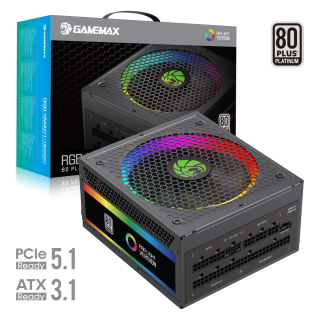
GameMax RGB 1300w PC power supply, 80 Platinum Certified,modular power supply
• 1300W Power: Fully modular, 80+ Platinum Certified, 92% efficiency
• Advanced Design: LLC+DC-DC with powerful single +12V rail.
• Compatibility: Supports ATX 3.0/3.1, PCIe 5.0/5.1, 16-pin 12V-2*6 for latest GPUs.
• RGB Lighting: 140mm ARGB fan with 25 lighting modes, syncs with major motherboard brands.
• High-Quality Components: Japanese bulk capacitor for durability and stability.
• Quiet Cooling: 140mm ultra-quiet fan with automatic temperature control.
• Wireless Design: Wireless design for cleaner setup and better heat dissipation.
• Comprehensive Protection: OPP/OVP/UVP/SCP/OCP/SIP for stability and safety.

