
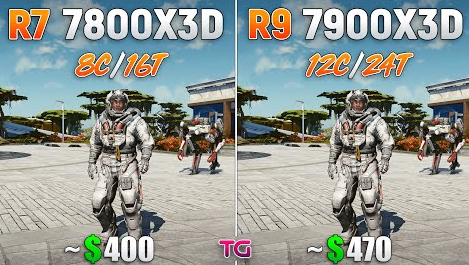
In the ever - evolving world of PC hardware, choosing the right CPU can be a daunting task. When it comes to AMD's Ryzen 7000 series, the 7800X3D and 7900X3D have caught the attention of many enthusiasts. Both processors offer unique features, but which one is the better fit for your PC? Let's find out through a detailed comparison.
Processor | Ryzen 7 7800X3D | Ryzen 9 7900X3D |
Cores | 8 | 12 |
Threads | 16 | 24 |
Base Clock | 4.2 GHz | 4.4 GHz |
Boost Clock | Up to 5 GHz | Up to 5.6 GHz |
L1 Cache | 512 KB | 768 KB |
L2 Cache | 8 MB | 12 MB |
L3 Cache | 96 MB | 128 MB |
Default TDP | 120W | 120W |
Price (approximate) | $399 | $499 |
The Ryzen 9 7900X3D clearly has an edge in the core and thread department with 12 cores and 24 threads compared to the 8 - core, 16 - thread configuration of the Ryzen 7 7800X3D. This makes the 7900X3D more suitable for multitasking and applications that can take full advantage of a large number of cores, such as video editing, 3D rendering, and virtualization.
The 7900X3D also has a higher base clock speed of 4.4 GHz and can boost up to 5.6 GHz, while the 7800X3D has a base clock of 4.2 GHz and a maximum boost of 5 GHz. In single - core tasks, the 7900X3D may have a slight advantage due to its higher clock speeds.
Cache is crucial for CPU performance as it provides fast access to frequently used data. The 7900X3D has a larger total cache with 128 MB of L3 cache, compared to the 7800X3D's 96 MB. However, it's important to note that the way the cache is utilized can vary between the two processors, especially in gaming scenarios.
Price is often a deciding factor for many consumers. The Ryzen 7 7800X3D is more affordable, coming in at around \(399, while the Ryzen 9 7900X3D is priced approximately at \)499. This price difference may influence your decision, especially if you are on a budget.
Gaming performance is a major consideration for many PC users. AMD's 3D V - Cache technology, present in both processors, aims to improve gaming performance by reducing latency.
In gaming, the 7800X3D has shown remarkable performance. Since all 8 of its cores are equipped with the 3D V - Cache, it can provide excellent single - core and multi - core gaming performance. Games that are more CPU - bound, such as esports titles like Counter - Strike: Global Offensive and League of Legends, see significant improvements in frame rates. For example, in CS:GO, the 7800X3D can achieve extremely high frame rates, ensuring a smooth and responsive gaming experience.
The 7900X3D, despite having more cores and a higher clock speed in theory, doesn't always outperform the 7800X3D in gaming. This is because the 3D V - Cache on the 7900X3D only affects one of its two chiplets (6 cores). So, in games that rely heavily on the benefits of the 3D V - Cache, the 7800X3D may actually perform better. However, in games that can scale well across multiple cores and threads, the 7900X3D may show an advantage. For instance, in open - world games like Assassin's Creed: Valhalla, the 7900X3D can use its additional cores to maintain high frame rates in complex scenes.
If your primary use for the PC is gaming, especially CPU - bound games, the 7800X3D offers great value for money. It can provide excellent gaming performance at a more affordable price point. However, if you play a mix of games, some of which are highly multi - threaded, the 7900X3D may be a better choice, but you'll have to pay the premium for it.
Productivity applications have different requirements compared to gaming. Let's see how the two processors stack up in this area.
The 7800X3D, with its 8 - core configuration, can handle basic productivity tasks like web browsing, word processing, and spreadsheet work with ease. However, when it comes to more demanding tasks such as video editing, 3D modeling, and running virtual machines, its performance may be limited compared to the 7900X3D. For example, in video editing software like Adobe Premiere Pro, rendering times may be longer on the 7800X3D due to its fewer cores.
The 12 - core, 24 - thread Ryzen 9 7900X3D is better suited for productivity tasks. In applications that can fully utilize its multiple cores, such as 3D rendering in Blender or running multiple virtual machines simultaneously, it can significantly outperform the 7800X3D. The higher clock speeds also contribute to faster processing of single - threaded tasks within these applications. For instance, in a 3D rendering project with complex geometry and textures, the 7900X3D can complete the rendering process in a much shorter time compared to the 7800X3D.
If your PC is mainly used for productivity work, especially tasks that require a high number of cores and threads, the 7900X3D is the clear winner. It can handle demanding applications more efficiently, saving you time and increasing your overall productivity.
Power consumption and heat generation are important factors to consider, as they can affect your electricity bill and the cooling requirements of your PC.
Both processors have a default TDP of 120W, but in real - world usage, the 7800X3D may consume slightly less power, especially in gaming scenarios. This is because it has fewer cores to power. In terms of thermals, the 7800X3D can run relatively cool, but proper cooling is still recommended to ensure stable performance. A good air cooler or a liquid cooler can keep the temperatures in check, even during extended gaming sessions.
The 7900X3D, with its higher core count and potentially higher clock speeds during certain tasks, may consume more power than the 7800X3D. This also means that it generates more heat. To keep the 7900X3D cool, a high - quality cooling solution is essential. Liquid cooling is often recommended for this processor to ensure it stays within safe temperature limits, especially during heavy multitasking or long - term use of demanding applications.
If power consumption is a concern for you, the 7800X3D may be a better choice, especially if you use your PC mainly for gaming. However, if you are willing to invest in a good cooling solution and don't mind the slightly higher power consumption, the 7900X3D's performance in productivity tasks may outweigh these factors.
Overclocking can further enhance the performance of your CPU, but it also requires careful consideration of power, cooling, and stability.
The 7800X3D has some overclocking potential. Users have reported being able to push the clock speeds slightly higher, which can lead to even better gaming performance. However, due to the 3D V - Cache technology and the already optimized factory settings, the gains from overclocking may not be as significant as in some other processors.
The 7900X3D also has overclocking capabilities. With its higher base clock and core count, overclocking can potentially unlock even more performance in both gaming and productivity tasks. But, like the 7800X3D, overclocking the 7900X3D requires proper cooling and may not result in massive performance boosts due to its advanced architecture and factory - tuned settings.
Overclocking can be a viable option for both processors if you want to squeeze out a bit more performance. However, it's important to note that overclocking may void the warranty, and proper precautions need to be taken to ensure system stability.
In conclusion, choosing between the AMD Ryzen 7 7800X3D and Ryzen 9 7900X3D depends on your specific needs. If you are a gamer on a budget or mainly play CPU - bound games, the 7800X3D offers excellent gaming performance at an affordable price. It also consumes less power and is relatively easy to cool.
On the other hand, if your PC is used primarily for productivity work, especially tasks that require a large number of cores and threads, such as video editing, 3D rendering, and virtualization, the Ryzen 9 7900X3D is the better choice. Despite its higher price and power consumption, its performance in these applications can significantly improve your workflow and save you time.
Ultimately, carefully consider your usage patterns, budget, and performance requirements before making a decision. Both processors are great options within the AMD Ryzen 7000 series, but the right one for you depends on your unique circumstances.

