
In the history of PC hardware development, LGA 1151 motherboards have emerged as one of the most legendary product lines in Intel platforms, thanks to their five-year market lifespan and cross-generational compatibility. Debuting in 2015 alongside the 6th Gen Core processors (Skylake) and remaining in use until replaced by the LGA 1200 socket in 2020, LGA 1151 motherboards witnessed pivotal transitions in the PC industry—from the popularization of DDR4 memory to the rise of NVMe storage. Even today, they maintain robust vitality in the second-hand market.
The success of the LGA 1151 socket stems from its flexible chipset ecosystem. Intel released over a dozen chipsets for this socket, covering needs from entry-level to flagship: Z170/Z270/Z370/Z390 target high-end users, supporting overclocking and multi-GPU setups; B250/B360/B365 cater to mainstream users, balancing performance and cost; H110/H310 focus on entry-level markets, offering basic functionality. This segmentation allows DIY enthusiasts to precisely match hardware needs—for example, gamers might choose the ASUS ROG STRIX Z390-I GAMING, while office users could opt for the Gigabyte H310 D3.
The compatibility pitfalls between socket versions are the most confusing aspect of the LGA 1151 platform. The socket has two versions: v1 (initial) and v2 (revised). V1 supports 6th Gen (Skylake) and 7th Gen (Kaby Lake) Core processors, with representative chipsets like Z170/B150/H110; v2 supports 8th Gen (Coffee Lake) and 9th Gen (Coffee Lake Refresh) processors, corresponding to chipsets such as Z370/Z390/B360. Their physical pin definitions differ, and cross-version mixing can cause hardware damage—a common issue for users upgrading their systems.
In terms of memory support, LGA 1151 motherboards exhibit hallmarks of a technological transition period. Early models like the MSI H110 PC MATE only support DDR4-2133 memory, with a maximum capacity of 32GB. To accommodate older memory, some manufacturers released specialized models: the Huanan Gold H311M-I innovatively features 2 DDR3 laptop memory slots, supporting 1866/1600MHz specifications with a maximum capacity of 16GB. This flexible design enables the LGA 1151 platform to adapt to diverse user upgrade needs.
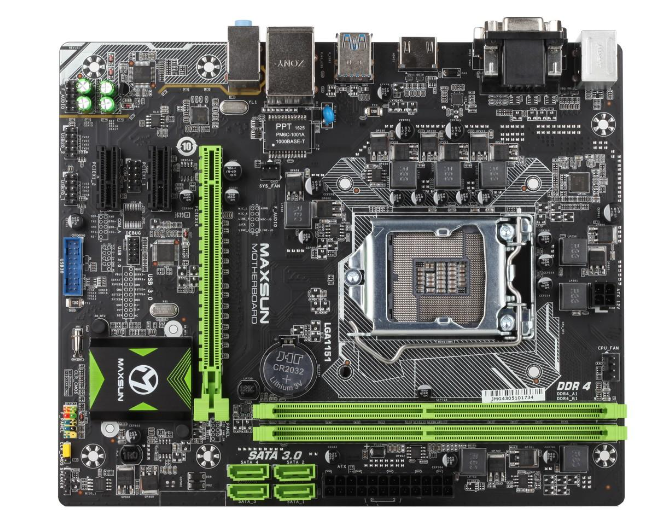
LGA 1151 motherboards played a crucial role in storage interface innovation. Mid-generation chipsets like B360/Z370 generally include M.2 slots supporting high-speed NVMe SSDs. Premium models, such as Maxsun’s LGA 1151 motherboards, even offer dual M.2 slots and support Intel Optane memory acceleration, significantly boosting system responsiveness. This design greatly 推动 the popularization of NVMe storage between 2017 and 2019.
The PCIe 3.0 bus serves as the performance cornerstone of the LGA 1151 platform. Mainstream chipsets provide 16 PCIe 3.0 lanes, supporting full-speed operation of a single GPU or multi-GPU CrossFire (e.g., Z390 supports 8+8 lane splitting). Though lacking PCIe 4.0 technology from later platforms, PCIe 3.0 shows no significant bottlenecks for RTX 20-series and older GPUs in real-world use—one reason the platform remains favored by entry-level gamers in 2025.
Differences in power supply design directly determine the overclocking capability of LGA 1151 motherboards. Flagship Z-series models like the Gigabyte Z370 AORUS Gaming 7 use 12-phase digital power supplies, stably supporting overclocking for the i9-9900K. H-series motherboards, typically with 4-6 phase power supplies, are better suited for locked processors. This differentiated design allows users with varying budgets to find suitable options.
In 2025, with soaring prices of new platforms, LGA 1151 motherboards have gained a new lease on life through their cost-effectiveness in the second-hand market. A combo of i5-9400F and B360 motherboard costs around 1,000 RMB, meeting 1080P gaming and daily office needs while saving over 50% compared to new platforms. Data shows that second-hand transactions of LGA 1151 motherboards exceeded 300,000 units monthly in the first half of 2025, with models like ASUS B360M-PLUS GAMING S and MSI B360M MORTAR leading due to their stability.
For hardware collectors and retro-building enthusiasts, the LGA 1151 platform holds special significance. It is the last mainstream platform supporting traditional BIOS updates and a witness to the transition from the "tick-tock" era to performance leaps. Many enthusiasts specifically collect end-of-line models like Z390, pairing them with i9-9900KS to build nostalgic gaming rigs, experiencing classic games like Cyberpunk 2077 on 当年的旗舰 hardware.
The technical legacy of LGA 1151 motherboards continues to influence modern platforms. Their modular chipset design and memory controller architecture have been carried over to LGA 1200/1700 platforms, while the popularization of M.2 slots has become a standard feature in modern motherboards. This bridging of past and present ensures their indelible mark in PC hardware history.
From 2015 to 2025, LGA 1151 motherboards have proven the enduring value of an excellent hardware platform over a decade. They not only served as a bridge for Intel platforms transitioning from DDR3 to DDR4 but also perfectly embodied the "upgrade-on-demand" philosophy in DIY culture. Even as cutting-edge hardware enters the 7nm era, the LGA 1151 platform continues to serve millions worldwide, thanks to its unique compatibility, repairability, and cost-effectiveness.

