
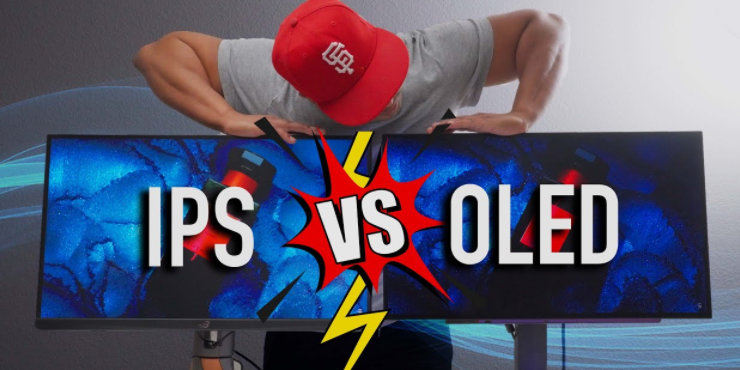
In the monitor market, OLED and IPS are two popular technologies, each with its own advantages and disadvantages, often leaving consumers in a dilemma. Which one is more suitable for you? This article will provide a detailed analysis from the aspects of technical principles, core differences, applicable scenarios, etc., to help you make an informed decision.
OLED (Organic Light - Emitting Diode) is a self - luminous technology, where each pixel can emit light independently and control its brightness independently. This means that when displaying black, the pixels can be completely turned off without relying on a backlight. IPS (In - Plane Switching), on the other hand, is a type of liquid crystal display. Its pixels do not emit light by themselves and need to be illuminated by a back LED light source. It controls the light transmittance through the deflection of liquid crystal molecules to present different colors and brightness.
The difference in this technical principle is the root cause of many differences in the performance of the two.
OLED: Thanks to its self - luminous feature, OLED monitors have almost infinite contrast. They display black extremely purely, presenting deep and pure black images with rich details in dark scenes. At the same time, it has high color saturation, natural color transitions, and excellent HDR effects, which can bring a very impactful visual experience.
IPS: The advantages of IPS monitors lie in color accuracy and viewing angles. It has strong color reproduction ability, and the color accuracy value is usually low, which is suitable for professional design, image editing and other work that has high requirements for colors. Moreover, the IPS panel has a wide viewing angle, and the attenuation of color and brightness is relatively small when viewing the screen from different angles.
OLED: The response speed is extremely fast, generally within 0.1ms, and there is almost no motion blur. For fast - moving images, such as competitive games and action movies, it can present clear and smooth effects, which can greatly improve the operating experience of game players.
IPS: The response speed is relatively slow, usually around 5 - 8ms. Although some high - end IPS monitors can achieve a faster response speed through technical optimization, there is still a certain gap with OLED, and there may be slight motion blur in rapidly changing images.
OLED: Due to the attenuation characteristics of organic materials, the service life of OLED monitors is relatively short, generally about 30,000 - 50,000 hours. If static images are displayed for a long time, screen burning may occur, that is, persistent afterimages are left on the screen. However, with the continuous development of technology, the new generation of OLED monitors has been significantly improved in terms of service life and anti - burning performance.
IPS: It has a longer service life, usually 60,000 - 100,000 hours, and there is no problem of screen burning. It is more durable and suitable for scenes with long - term and high - frequency use.
OLED: When displaying dark images, the power consumption is low because the black pixels can be turned off; but when displaying bright images, the power consumption will increase significantly, and the heat generation is also relatively more.
IPS: The power consumption is relatively stable, and the fluctuation of power consumption is small regardless of the image displayed, and the heat generation is also mild.
OLED: Due to the high technical cost, the price of OLED monitors is generally high, especially large - size and high - resolution models, which are often much more expensive than IPS monitors of the same specification.
IPS: The price is relatively affordable and has a higher cost - performance ratio, which is a better choice for consumers with limited budgets.
If you are a competitive game enthusiast pursuing extreme image quality and response speed, an OLED monitor is a better choice. It can let you take the lead in the game and get a more immersive experience.
If you mainly play some 3A masterpieces that have high requirements for color and image details and are sensitive to price, an IPS monitor can also meet your needs.
For professionals engaged in graphic design, video editing, post - photography and other work, IPS monitors are the first choice. Its excellent color accuracy and wide viewing angle can ensure the accurate color reproduction of works and avoid affecting the quality of works due to display problems.
Daily office work has relatively low requirements for monitors. If the budget is sufficient, the excellent image quality of OLED monitors can bring a better user experience; if the budget is limited, an IPS monitor can fully meet the office needs.
When used for watching movies, TV dramas and other entertainment activities, the high contrast and excellent dark field performance of OLED monitors can bring a cinema - like viewing experience; IPS monitors have a more balanced color performance, which is suitable for various types of video content.
If you pursue extreme image quality and response speed, have sufficient budget, and can accept the relatively short service life and the possible risk of screen burning, an OLED monitor is a good choice.
If you value color accuracy, service life and cost - performance more, and mainly use it for professional design or long - term office work, an IPS monitor will be more suitable for you.
In addition, when purchasing, you also need to consider factors such as screen size, resolution, and refresh rate, and make a comprehensive choice based on your own usage needs and desktop space. No matter which monitor you choose, as long as it meets your own needs, it is the best choice.

